
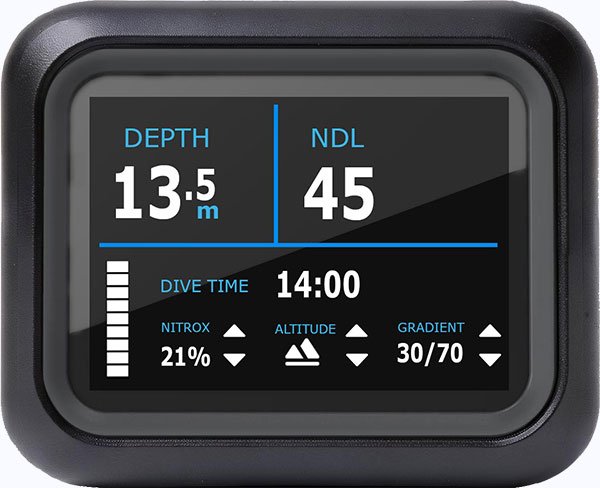
All entry-level dive students should learn how to plan a dive during their open water course. We used to sit down and explain the RDP tables, which many students found very abstract and difficult to understand. Nowadays most instructors give their students a dive computer during their course dives, which makes our lives much easier.
But I noticed many divers use their computer as a glorified timer and depth gauge, and fail to properly understand its functions. I’ve had many divers show their rental computer to me (that was in ‘error’ mode) and ask me, “It’s broken. Can I get another one?” Unfortunately, I had to tell them they were done diving for today.
Even during the PADI IDC, I spend a lot of time explaining partial pressure, M-values, tissue compartments, and so on. Knowledge that students should have picked up during their Divemaster course, but don’t fully grasp yet. I find myself drawing dive profiles and compartment graphs on a whiteboard. Not the best way to explain it.
So I built something better. A dive computer simulator you can actually mess with, right in your browser, no dive gear required.
You can try it here: Dive Computer Simulator
What it actually does
This isn’t a fancy dive planner or something meant to replace your actual computer on a dive. It’s a simplified model built to show you what’s happening under the hood when a real dive computer calculates your no-decompression limit.
You create a dive profile, hit start, and watch the simulation run. You can speed it up (20x by default), and you can see your NDL counting down in real time as your tissues load up with nitrogen.
The part I think is actually useful, not just neat, is the tissue compartment display. It shows fast compartments and slow compartments loading at different rates. It shows the nitrogen levels going down during a surface interval, and it shows your residual nitrogen load on a second dive. If you’ve got a student who’s confused about why their buddy’s computer gave a different NDL on the same dive, this is a good way to show them why, instead of just telling them.
This makes it a great teaching tool. You can show what happens when you reach your limits and (even though we don’t teach decompression stops to recreational divers) what you should do if you accidentally exceed your limits. You can also play with gradient factors, switch between air and nitrox, and even factor in altitude.
Who this is for
Honestly, anyone. Open water students who are learning how to use their dive computer. Divemasters and instructor candidates who are trying to wrap their heads around decompression theory. Working instructors who want a quick visual aid for a classroom session instead of drawing tissue compartments on a whiteboard.
Newly certified divers who get a rental computer pressed into their hands and don’t really know how to use it. Experienced divers who are planning to buy a dive computer and are trying to make sense of all the specs they read about online.
What it’s not
Don’t use this to plan an actual dive. It should be pretty accurate, but it’s a simplified model built to teach a concept, not a certified dive planning tool, and it says so right when you open it. Your real dive computer, properly set up and maintained, is what you dive with. This is what you use to understand what that computer is doing.
Try it out. It’s completely open and free to use. I built this because I got tired of explaining tissue loading on a whiteboard, and if it helps you teach your students about dive computers, that would be great.
If you’re working through your own IDC and want more resources like this, get in touch.
I’m actually considering creating an in-depth “dive computer course” built around this simulator. Let me know if you think such a course would be useful, and what you’d like to see in it.
This article was written by Marcel Jansen, PADI Course Director and founder of Asia Scuba Instructors. Marcel has been in the diving industry for over 20 years, teaching across Thailand, Indonesia, the Philippines, the Maldives, and Malaysia.
He runs PADI Instructor Development Courses across Asia and has strong views about how this industry trains its people.
Interested in becoming a dive professional? Find out more at asiascubainstructors.com.